The report
What a review of your game actually shows
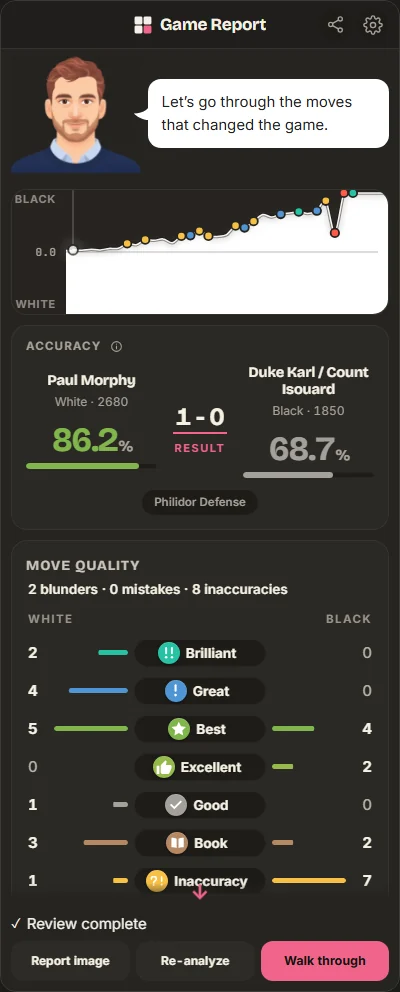
A grade under every move is the start, not the answer. The report is the part you read after the game: two accuracies, a curve of who was winning, the moves that bent it, and a plain sentence explaining each one.
Chess accuracy for both sides, and where the number comes from
Both players get an accuracy, including the one who won. It is not a count of good moves and it is not a score for the opening. Every move is scored on how much winning chance it gave away, measured from Stockfish’s own evaluation before and after the move.
Those per-move scores are averaged over the moves that player actually made, using the published accuracy formula rather than a scale invented for this page. The browser’s measured loss is first scaled onto that formula’s reference curve, because a fixed-depth search sees smaller losses than a deep cloud search; the calibration is what keeps the number comparable. A move that gives nothing away scores 100, and a move that turns a won position into a lost one costs far more than several small slips, because that is what it did to the game.
The same number is then split into the opening, the middlegame and the endgame, so a clean opening and a ragged finish do not average into a comfortable lie. A dash in one of the three rows means the phase had no graded moves at all, not that it scored zero.
The full pipeline — import, engine, grades, report — is on the walkthrough page. This page is what comes back at the end of it.
The game rating is a reading of one game
Beside the accuracies is a game rating: a blend of 70% of your current rating and 30% of the rating your accuracy implies. Your rating is the prior, because one game cannot measure a player. The accuracy moves that number up or down for this game only; the result, the opponent’s strength and the time control are deliberately left out.
When the PGN carried no rating for either player, there is no prior to adjust, so the estimate falls back to what that accuracy is worth on the open rating scale. The report says “≈” because the number is an estimate, not a new official rating.
It also does not force the winner to have the higher number. If one side played the better chess and still lost, the report shows that; ordering the two numbers to match the result would invent a fact the game does not support.
The evaluation curve, and the moves that bent it
The curve runs ply by ply across the game, from the first move to the last, and it is drawn from the same evaluations as the grades. Read it left to right and you are reading who was winning: the higher the curve, the better for White, and the lower it sits, the better for Black. The steep sections are where the game changed hands.
These grades put a dot on the curve: Blunder, Mistake, Inaccuracy, Brilliant and Great — and Best earns a single dot in a long quiet stretch, one per run of four or more plies with none of the five. Excellent, Good and Book never get one. The dots are there so a steep section has a name attached to it.
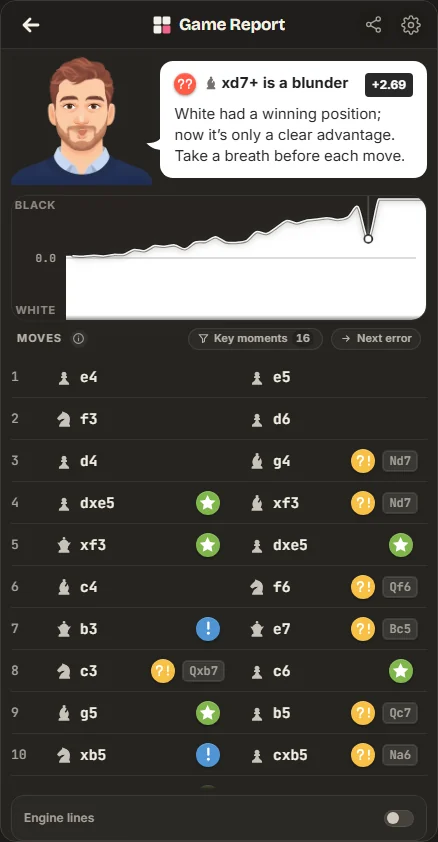
Under the curve, the decisive move gets its own card: the move that cost the most win chance, what it allowed, and the move that held the position better. The turning-point list follows worst first, so the reader meets the biggest swing before the smaller ones.
The nine grades, and what each one means
Each move the engine grades gets one grade, on the scale chess players already read. The grade is about the move that was played; the sentence under it is where the context lives.
Brilliant
A sound sacrifice the engine agrees with
Great
The only move that keeps your advantage
Best
The engine’s top choice
Excellent
Almost the best move
Good
A reasonable move
Book
A known opening move — the theory line
Inaccuracy
A small step backwards
Mistake
A real chance thrown away
Blunder
A game-changing error
Book is the one grade that is recognition rather than judgement. A move is marked Book when it belongs to the opening book this app ships and it did not cost an inaccuracy’s worth of winning chance. One line of theory has several good moves, so a browser engine crowning one of them would be inventing a verdict.
There is no separate “missed” grade. The app grades the move you played, and when the engine found a better move worth playing instead, the slip names it — “Play Nf3 instead” — with the reason. Adding a tenth chip for the move you did not play would say the same thing twice and make the move that was played look like something other than what it was.
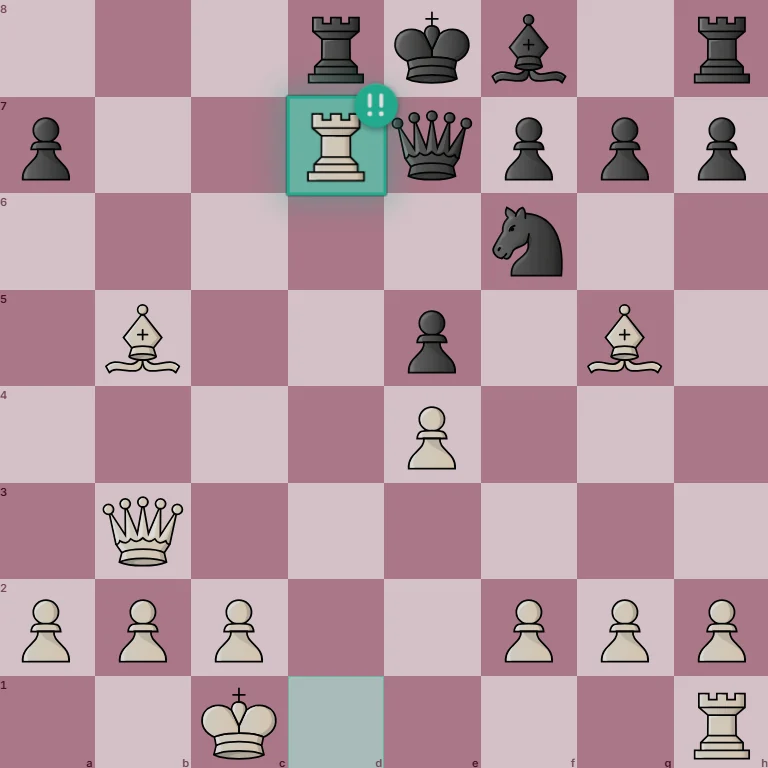
The per-move slip: a verdict, an evaluation, one sentence
Step onto any move and the feedback card gives you three things: the grade, the evaluation behind it — the winning chance the move gave away — and one sentence saying what the move did. The sentence is built from a fact about the position where there is one, and stays plain where there is not; it does not invent a story to fill the card.
Where the move cost enough to matter, the card also names the better move and can play it on the board. The cost is shown in win chance, because that is the unit the grade was decided in — a move that drops a pawn in an already-lost position is not the same event as one that drops the game.
Book moves get the badge and no reason sentence: “e4 is book” is the whole verdict. Leaving a known line is where the grading starts.
The game’s story, without a narrator
There is no generated paragraph at the top of the report telling you what kind of game it was. The story is assembled from the evidence and left in the order it happened: the opening the game reached, the accuracies, the phase split, the decisive move, the turning points, and every move’s own sentence.
That is deliberate. A written summary can only be as honest as its weakest sentence, and a review that invents a narrative to sound confident is harder to trust than one that shows you the curve and lets you read it. The report’s job is to make the game legible, not to perform an opinion about it.
The whole report also exports as one designed image you can save or share, and the game keeps a share link that opens it at the position you were looking at.
What the report does not claim
The report is only useful if it is straight about the engine behind it.
- The search is a fixed-depth browser search. It runs on your device, not a cloud cluster, so it will miss small losses that a deeper search sees. The accuracy is calibrated to the reference scale so the number stays comparable; that does not make the search identical to a cloud review.
- Book is recognition, not judgement. A known opening move is not crowned the best move, and leaving the book is where the grading begins.
- The game rating is an estimate for this game. It is not an official rating and it does not measure the player.
- The report only speaks about the moves it saw. A game that could not be read in full says so; a phase with no graded moves shows a dash rather than a number.
No account. The board opens first, and the report follows.